
Is demand-responsive transport just an expensive hobby?
As the name implies, on-demand transport operates in response to a request—that is, when needed. Taxis and ride-hailing services like Uber and Bolt can be considered examples of on-demand transport. It qualifies as public transport when multiple passengers are picked up at once and the service either replaces or complements traditional public transport.
Demand-responsive public transport operates in cycles. From time to time, a phenomenon builds up around it, during which demand-responsive transport is expected to revolutionize the current world order at any moment. Most of the time, however, it is like a moray eel hiding in its crevice, living and breathing while waiting for better days.
On-demand transport was last widely championed about a decade ago. At that time, every self-respecting automaker had its own on-demand service—or at least a software division that included on-demand capabilities in its portfolio. Investors poured vast sums of money into the sector, and—alongside MaaS and autonomous vehicles—on-demand transport was expected to irrevocably disrupt the traditional playbook of the transportation industry.
If you ask an AI lurking in the depths of the internet today to list companies in the sector that have ceased operations, you will get a string of names backed by the likes of Mercedes-Benz, Daimler (yes, listed separately), Ford, and Volkswagen.
Why, then, have expectations not been met?
The answer has two parts: 1) on-demand public transport is expensive to provide, and 2) private car use isn't simply going to disappear.
Following two extensive on-demand public transport trials, a representative of a domestic public transport operator remarked that, in both instances, “the surgery was a success, but the patient died”—meaning the service was implemented as planned and received excellent user feedback, yet required an unsustainable level of financial life support. Numerous on-demand transport pilots have been conducted in Finland alone under various pretexts, yet all too often, the service has been quietly shelved after the trial ended, deemed too costly.
In 2024, the price of gasoline remains a political weapon, and the costs of private motoring can—in the worst-case scenario—topple governments. The concepts of freedom of movement and the level of service provided by one’s own car are deeply ingrained in us. A well-worn cliché holds that a private car sits idle 80% of the time; a more relevant interpretation is that it is available 100% of the time.
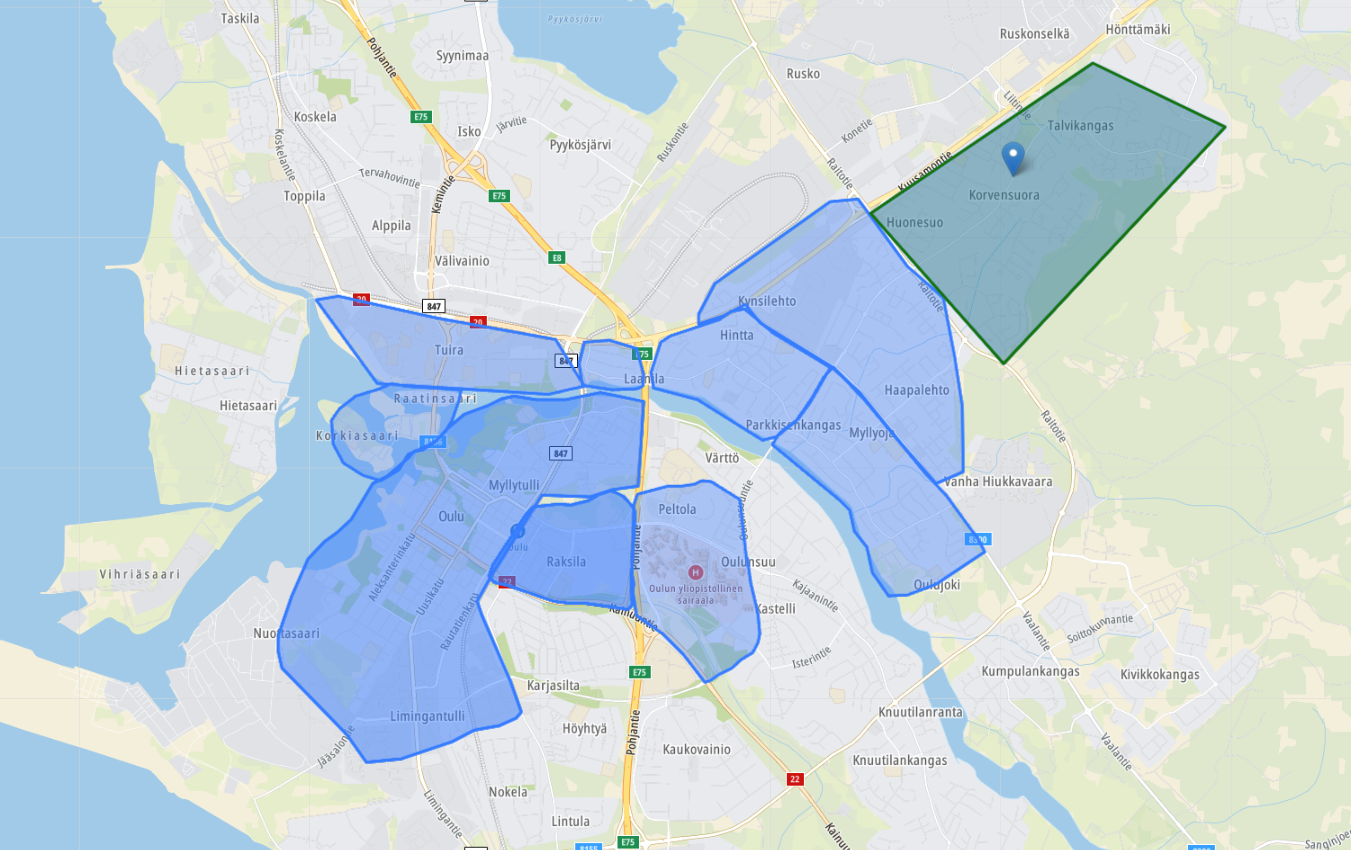
On the other hand, in Finland alone, there are dozens of on-demand public transport services open to everyone—services whose existence has been successfully justified, often on the grounds of cost-efficiency! In Oulu, the "Onni" service operates across 14 different routes. In Tampere, the "PALI" service provides transport across 20 routes. Matkahuolto’s "Reitit ja liput" (Routes and Tickets) service offers on-demand routes in Pietarsaari, Riihimäki, Porvoo, and Raahe, to name a few.
So, where do these services originate?
A vast number of people use public transport. Neither public transport nor on-demand transport services need to “put an end to private car ownership” or “destroy traditional taxi services” to find their user base. Let us therefore immediately set aside these arguments—often used by startups driven by a frenzy for funding—and focus instead on costs.
A common feature of many effective on-demand transport services is that they replace something even more expensive.
Transport services in accordance with the Disability Services Act and the Social Welfare Act are offered to people who cannot use public transport. Basically, the purpose of these services is to replace public transport, not to offer an individual transport service.
Demand-responsive public transport offers an accessible option that enables more people to use public transport. The economic benefit arises from the fact that travel entitlements under the Disability Services Act (VPL) and the Social Welfare Act (SHL)—which entail higher costs—can be granted less frequently and at a later stage, as open public transport has become more accessible.
Achieving this cost impact following the social and health care reform requires greater coordination between the authorities than before, since the costs of public transport are primarily borne by the municipality and the social and health services county.
The situation can also be viewed from the opposite perspective: statutory transport services under the Disability Services Act and the Social Welfare Act create a network of thousands of daily trips for the wellbeing services counties. Almost every trip involves one or more empty seats that could be made available as part of open public transport. It would be entirely feasible from a technical standpoint to organize the utilization of this capacity.
It is important to remember that VPL and SHL trips are provided for citizens with special needs regarding the level of transport service. Not all passengers are able to use shared transport. However, passengers are already profiled in this regard; a passenger’s service profile indicates whether they are suitable for shared transport or require a dedicated vehicle.
Demand-responsive services can be organized in a cost-effective manner—particularly when compared to the alternatives. These services can be significantly developed and expanded beyond their current scope while simultaneously achieving, for instance, the cost savings that wellbeing services counties so urgently need. However, this requires broader coordination than before, as the funding currently comes from separate pockets.
The moray eel remains in its crevice for now but is ready to dart out into view again when the time is right.